

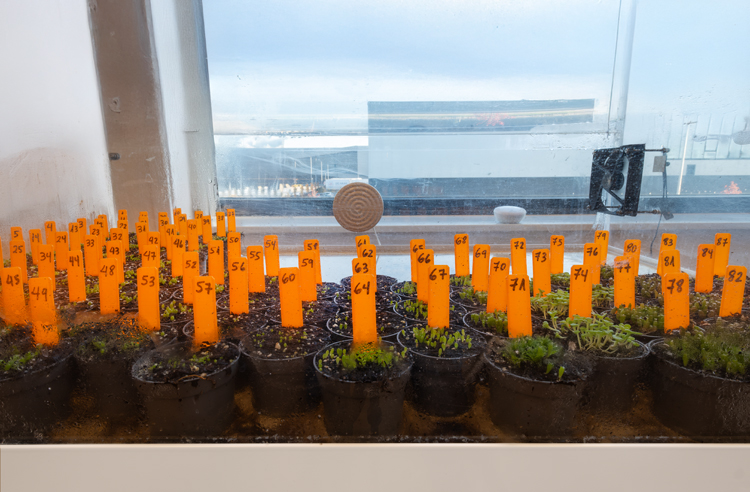
- First, clean and disinfect the seed trays or boxes and fill them with fresh soil.
- Place the trays on a flat, level surface so that all parts dry evenly.
- Use fine, light soil and press it down carefully until the surface is completely level and very flat.
- Lightly sprinkle the soil with water. The soil should be moist, but not soaking wet.
- Open the seed packet and sow the seeds directly onto the soil by gently tapping the packet and spreading the seeds evenly.
- Press the seeds lightly into the soil with a spatula (such as one used for masonry work).
- Immediately label the trays with the plant name and the date of sowing.
- Water the trays again using a mixture of water with Rovral or Topsin (1:1000 ratio) to help prevent mold.
- Cover the soil with a thin layer of fine gravel (2–3 mm in diameter). Do not use too much; the soil should be almost covered. This helps prevent algae growth and souring of the soil.
- Cover the trays with transparent plastic, making sure the plastic does not touch the soil. You can create small tunnels or supports to keep the plastic raised.
-
Although the ideal temperature for germinating cactus and succulent seeds is around 28°C, for succulents it is about 20°C. Some cactus species also germinate better at these lower temperaturen, for example Oreocereus, Parodia, Notocactus, and Rebutia.
For specific questions, you can always contact us.
- If it is very sunny and warm, open the plastic tunnel for half en hour each day after the first week. Close it again before evening to keep the warmth inside.
- Check the moisture level regularly. If the soil becomes too dry, mist it very carefully.
- Once germination is satisfactory, you can remove the plastic cover — usually after 2–3 weeks.
- If watering is needed later, it is best to water early in the morning, around 7 a.m.
- Exceptions: Agave, Cissus, and Aloes — lightly cover these seeds with a thin layer of soil or fine gravel.